
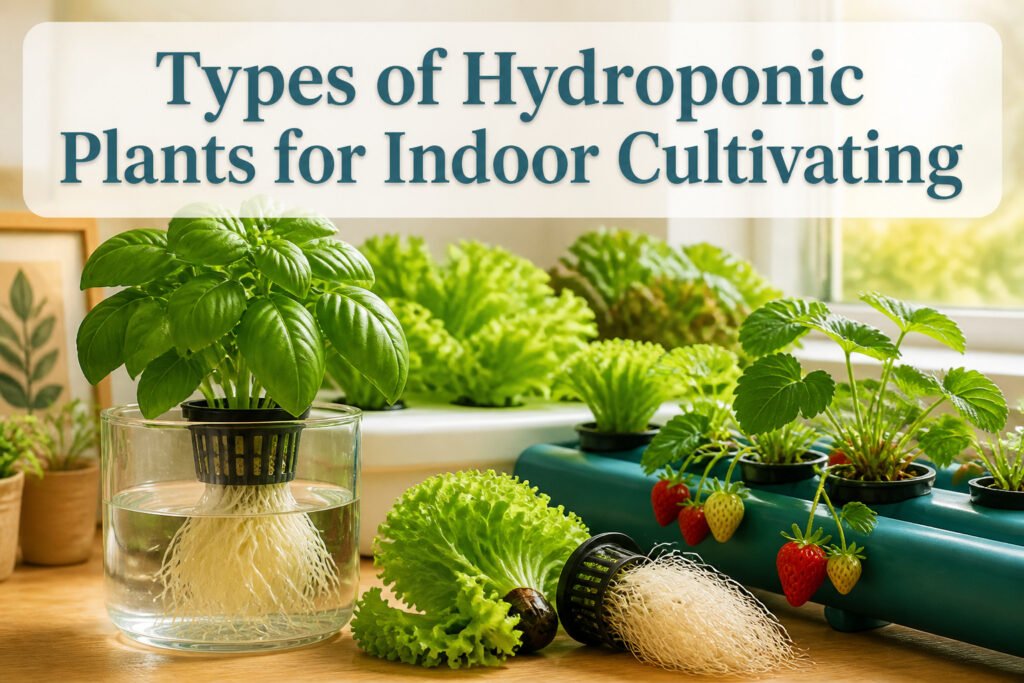
The best types of hydroponic plants for indoor cultivating are leafy greens and culinary herbs, provided you match the system to the root type rather than forcing every plant into deep water culture. That distinction matters because strawberries and fruiting crops need the oxygen exposure that nutrient film technique provides, while carrots and potatoes fail outright regardless of setup. I watched basil roots turn tea-colored in a stalled DWC bucket, then recover only after I added a second air stone rated for the same gallonage and let bubbles cross the full reservoir.
1. Leafy Greens
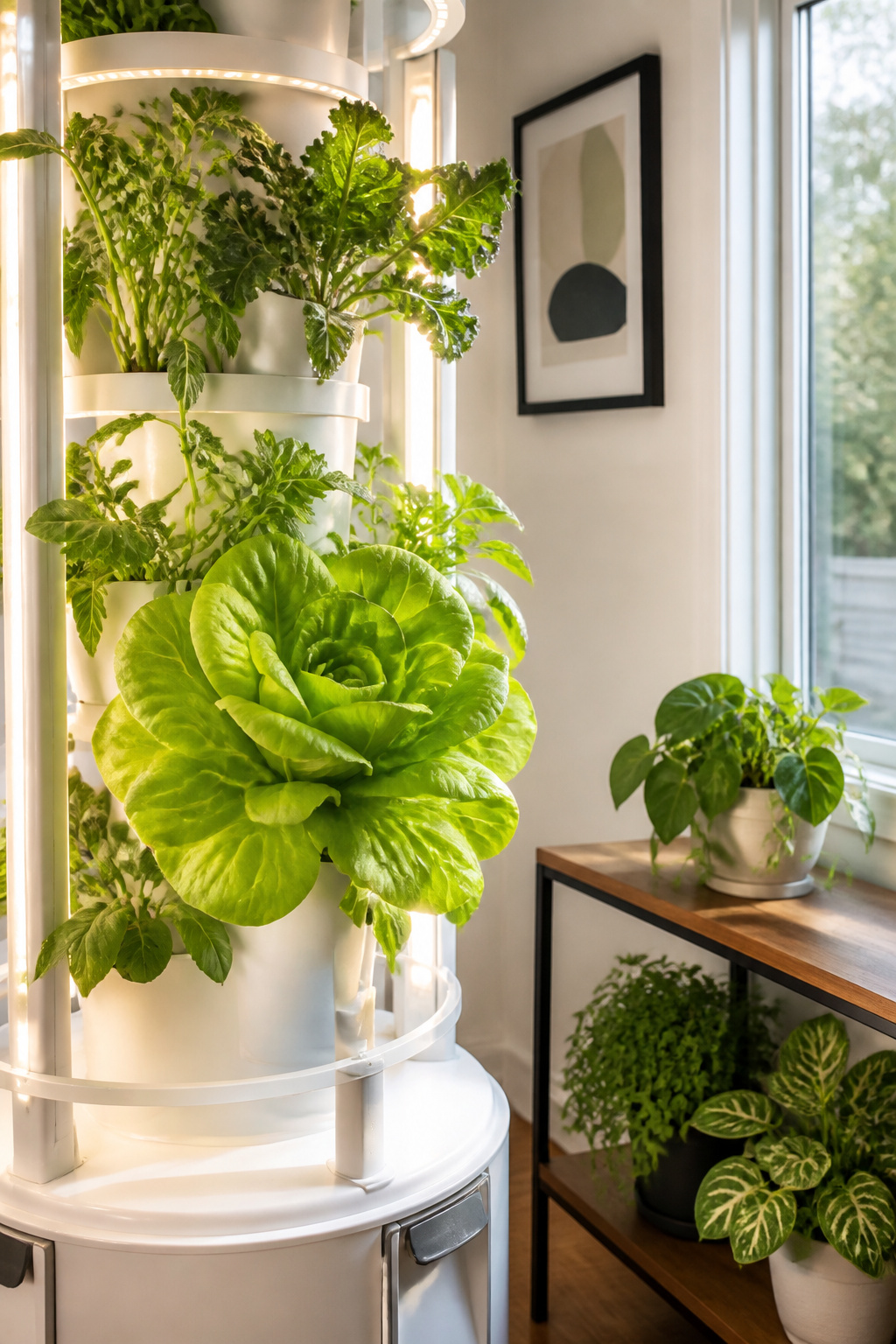
Lettuce, spinach, kale, arugula, mustard greens, Swiss chard, and Asian greens all share one trait that makes them ideal for hydroponic setups: shallow, fibrous root systems that spread wide rather than deep. These roots drink steadily from a thin film of nutrient solution without demanding the heavy feeding or structural support that fruiting crops require.
A butterhead lettuce can move from seedling to harvest in roughly 25–30 days, which is the payoff for choosing foliage over fruit. Spinach and Asian greens cycle nearly as fast, while kale and Swiss chard hang on longer but keep producing cut-and-come-again leaves for weeks. The quick turnaround matters when you are working a small system and want continuous harvests rather than one big event.
Light runs 12–16 hours daily under full-spectrum LEDs, and the nutrient solution stays in a pH range of 5.5–6.5. Greens tolerate denser spacing than almost anything else, so vertical towers, NFT channels, or a simple floating raft all return usable yield without wasted space. I started with lettuce partly because the mistakes are cheap: a pH drift or weak solution shows in pale leaves long before the plant collapses, and you are only a few weeks from starting over.
2. Culinary Herbs

Culinary herbs were my first attempt at hydroponic growing, and they taught me fast that leafy plants do not politely wait for nutrients. Basil, mint, cilantro, parsley, dill, chives, oregano, thyme, sage, and rosemary all adapt well to indoor systems, but their compact growth above the roots hides a surprisingly aggressive appetite below them.
Basil became my benchmark. From seed to first harvest in 3–4 weeks is the figure that gets repeated, and in my setup it held true only when I stayed on top of reservoir changes. The plant is a moderate feeder, but "moderate" means consistent, not stingy. Sudden drops in nutrient concentration slowed leaf production faster than any other variable I adjusted. Soft-stemmed herbs like basil and cilantro want steady moisture at the roots, while woody types such as rosemary and thyme need more oxygen and slightly drier conditions. I lost a thyme seedling early on by running it in the same deep-water culture that kept my basil lush.
The payoff of matching system to herb type is stronger flavor and repeated cuttings without plant stress. Parsley asks for more patience, 8–12 weeks to maturity, and cooler temperatures than basil tolerates. Dill stays shorter in hydroponics than it would in garden soil, provided you harvest regularly. Chives took 40–60 days in my first run, forgiving of temperature swings and light on maintenance. What all ten share is high nutrient uptake relative to their size; a reservoir that looks adequate for lettuce will leave herbs hungry halfway through a growth cycle.
3. Fruiting Vegetables

Tomatoes, peppers, cucumbers, eggplants, and squash demand more from a hydroponic setup than leafy greens ever will, but the payoff is measured in pounds rather than ounces. These plants need higher potassium and calcium the moment flowering starts; potassium drives sugar transport into developing fruit, while calcium prevents the blossom end rot that ruins a promising tomato overnight. I learned this balance the hard way after watching a full truss of cherry tomatoes blacken at the base because my nutrient mix stayed on the vegetative formula too long.
The physical support is just as critical. A mature hydroponic tomato can hit 24 inches tall and wider still, and a pepper loaded with fruit will topple without wooden stakes or trellising. Cucumbers grow fast enough to outpace their own structure in a matter of weeks. Root space, strong lighting for 14–16 hours daily, and careful pruning keep the plant’s energy directed toward fruit rather than stem. Get this right and the yield per square foot beats soil by a wide margin; the roots never compete for nutrients, so every calorie goes exactly where you want it.
4. Vining and Climbing Plants

Vining plants slot into vertical hydroponic systems almost by instinct. Cucumbers, peas, and beans all want height, and hydroponics feeds that elongation without the root rot that wet soil invites during heavy fruiting. The overlap with fruiting vegetables is real, cucumbers especially, but the vertical habit is what matters here: these are the crops that turn a narrow column into productive volume.
I rigged trellising from wire shelving I already had, the kind with half-inch grids. Cucumbers climbed it fastest, sometimes six inches overnight once the vine caught. Peas wrapped their tendrils through the same grid and held without tying. Beans needed a little guidance at first, a loose loop of twine to start them upward, then they ran.
Root space runs larger than lettuce or herbs demand. Cucumbers in particular want volume; I learned that when a root mat choked a smaller reservoir and the leaves flagged before I caught it. The payoff is yield density. A single column of trellised snap peas in a two-foot footprint outproduced the same area of bush habit, and the harvest stayed cleaner, off the floor and away from splashed reservoir water.
Bush beans stay compact and skip the trellis work entirely. That is the trade if your ceiling is low or your patience for training is thin. Pole beans and climbing peas repay the effort with longer production windows, more pickings over more weeks. Wire shelving trellising costs nothing extra if you already store pots on it, and the grid spacing is tight enough that tendrils grip before the vine weights down.
5. Strawberries and Small Fruit Crops

Strawberries reward hydroponic growers with fruit that stays clean and ripens evenly, lifted off the soil where moisture and rot usually claim the first harvest. In a soil bed, runners spread where they want and root wherever they touch down; in a system like NFT, ebb and flow, or a vertical tower, those same runners dangle without finding purchase, so the patch stays where you put it. The roots draw steady water without sitting in it, which matches what the plant prefers. A cycle of about 60 days from start to first fruit is typical, and nutrient timing can shift toward flowering and fruiting phases without the guesswork of weather. Dwarf blueberries or other small fruits can go hydroponic too, though they ask for tighter pH control and more specialized feeding than strawberries do. For a small indoor setup, strawberries in a vertical tower give you the cleaner fruit and the controlled spread in the same footprint.
6. Microgreens

Broccoli, radish, kale, and pea shoots all work as microgreens because they germinate fast and reach harvest size in days, not weeks. The shoots carry intense flavor and nutrition in a tiny package, which is why restaurants pay premium for them. In my own trays, the temptation is always to sow thickly and get more yield per square inch. That density backfired twice last winter when the canopy stayed wet and mold colonized the stems before I could cut. A thin, even layer of seed with gentle airflow underneath solves most of the problem and still fills a salad bowl faster than full-grown kale ever could. The tradeoff is frequency: microgreens demand reseeding every 7–14 days, whereas a mature kale plant in water culture needs 50–55 days but then produces for months. For a small indoor setup, the math usually favors the quick turnover.
7. Ornamental Plants

Peace lilies, pothos, philodendrons, and orchids already live in millions of homes, and most of them handle a full switch to water better than their owners expect. These plants evolved in tropical settings where roots cling to bark, moss, or leaf litter rather than proper soil, so a hydroponic setup removes a middleman they never needed.
My own pothos sat in a 6-inch terra-cotta pot for two years before I tried water propagation. I cut a 5-inch tip just below a node, kept two nodes submerged, and watched white roots appear in under ten days. That jar stayed on a kitchen shelf for another year before I moved the plant to a simple Kratky-style container with diluted nutrient solution. The shift from soil to water to full hydroponic culture was gradual, which is the safer route for a plant you already own rather than betting the whole root system at once.
Peace lilies need filtered water, since tap chemicals hit their roots harder than soil would buffer. Orchids, particularly the phalaenopsis types sold in grocery stores, adapt to semi-hydroponic culture with their aerial roots left partly exposed. The payoff is less about faster growth and more about consistent health: fewer fungus gnats, no dry pockets in the pot, and leaves that stay the same deep green month to month.
8. Plants That Perform Poorly

Some plants fight the system itself. Carrots, potatoes, onions, and garlic all share the same problem: they need room to expand underground that hydroponic setups simply do not give them. The whole point of hydroponics is suspending roots in nutrient solution, not packing them into soil-like media deep enough for a taproot to run.
I learned this with carrots in a standard net pot. The variety wanted six to eight inches of loose, unobstructed depth to form that single straight root. In the net pot, the roots hit the plastic mesh and branched instead, producing a tangle of thin secondary roots and nothing worth harvesting. The plant stayed green and alive, which made the failure slower and more confusing, since above the reservoir everything looked fine.
Potatoes layer tubers along a buried stem as they grow, onions and garlic swell bulbs below the surface. All of that growth happens where you cannot see it until harvest, and standard hydroponic channels or DWC reservoirs have no mechanism for it. The space inefficiency is the real killer: one lettuce occupies the same footprint and gives you usable leaves in weeks, while a carrot needs months for a single root that may still fork or stall. For a small indoor system, that trade is hard to justify.
Hydroponic Systems That Match Each Plant

Deep Water Culture suspends roots directly in oxygenated nutrient solution, making it the most forgiving entry point for leafy greens and compact herbs. I started there, running a simple tote bin with an aquarium pump and net cups for basil and butter lettuce. The roots stayed wet constantly, which suited those fast, shallow root systems, but my strawberries stalled. Their finer feeder roots wanted more oxygen than the stagnant zones in my bin provided.
Nutrient Film Technique sends a thin sheet of solution through angled channels, exposing roots to both liquid and air. This matches the airy, fibrous root mats of strawberries and smaller fruiting crops that the passages flag as needing specially designed flow systems. Ebb and Flow floods a tray on a timer, then drains completely, letting roots breathe between baths. That intermittent cycle handles mixed greens well and carries some buffer if the pump pauses briefly. Wick systems pull solution up passively through absorbent material, needing no pump at all, though they cap out at lighter plants like herbs and small greens that do not demand heavy feeding.
| System | Best for | Root type match | Why I moved on |
|---|---|---|---|
| Deep Water Culture | Leafy greens, herbs | Fast, shallow, tolerant of constant wet | Strawberries needed more oxygen than my bin gave |
| Nutrient Film Technique | Strawberries, small fruit | Fine, fibrous, high oxygen demand | n/a |
| Ebb and Flow | Mixed greens, herbs | Moderate, adaptable to wet/dry cycles | n/a |
| Wick | Small herbs, greens | Light, low water demand | n/a |
I shifted to Nutrient Film Technique for the fruiting crops after watching those strawberry roots brown at the tips in standing water. The continuous thin film gave them the air contact the passages describe as required, and harvest weight picked up within two weeks.
Light and Temperature Rules I Follow

Leafy greens and herbs both pull 12 to 16 hours of light per day, though they handle shortfall differently. Basil stretches and thins when under-lit; green onions simply slow down and stay slimmer. I run a cheap outlet timer on a full-spectrum LED panel, nothing fancy, and shift the schedule by half an hour each season to match what the plants would see outdoors in late spring. In January that means 12 hours; by April I am up to 15.
Temperature matters less than I expected, but stability does. Most of what I grow stays between 60 and 75 °F, the range palms tolerate, and my basement stays there naturally. A $10 digital thermometer/hygrometer is the only monitoring gear I use.
For pH, the nutrient solution wants to sit between 5.5 and 6.5. I test weekly with a three-dollar strip kit from the hardware store. When the reading drifts toward 6.8, I add a few drops of phosphoric acid solution; when it hits 5.3, I dilute with plain water and remix the reservoir at the next change. The strips read in half-point increments, so I am estimating within a quarter point, but leafy greens forgive that. They are shallow-rooted, fast-maturing, and harvested before flowering, which is why beginners lean on them.
The real seasonal adjustment is light angle, not duration. Winter sun through a south window is weak even at 12 hours, so the LED panel drops to six inches above the canopy instead of twelve. I raise it again once the outside days lengthen and the plants start showing darker, more compact growth.
Nutrient Solution and Water Changes

Water in a hydroponic system turns into a chemistry experiment the moment you add nutrients, and the plants have no backup if you get it wrong. Change the reservoir every two to four weeks so salts do not accumulate and choke the roots. I learned that timing the hard way after letting a basil tank go six weeks; the EC crept up unnoticed and the leaves yellowed from the edges inward.
Leafy greens like kale and basil are moderate feeders that want a balanced formula with adequate nitrogen. Fruiting plants need a different mix, heavier on phosphorus and potassium once they shift from leaf growth to setting fruit. I now keep two labeled jugs on the shelf and switch at the first sign of flowers.
The pH wants staying between 5.5 and 6.5, checked every few days with a cheap meter. Let it drift outside that band and the plants lock out nutrients even when the water looks dark with fertilizer.
My worst mistake came the first season, mixing full-strength solution for seedlings because the bottle said "general hydroponic use." The tender roots burned within forty-eight hours. Seedlings want quarter strength at most, scaled up only as the true leaves thicken.
Root Rot and the Problems I Actually Had

Root rot in a deep water culture bucket usually announces itself with a smell before anything visible shows up. Mine started with basil that wilted at noon despite full water, and when I lifted the net pot the roots were the color of weak tea instead of the creamy white they should have been. Brown roots slip off the stem when you tug gently; healthy ones hold firm and feel almost crisp. The air stone had gone quiet, a common failure if you run the pump continuously without checking for clogged diffusers. I swapped in a new one rated for the same gallonage, added it opposite the first so bubbles crossed the whole reservoir, and the next set of roots came in clean within ten days.
Thrips arrived on that same basil batch, probably hitchhiking on a six-pack from a greenhouse. The leaves silvered between the veins, and under a phone flashlight the tiny pale larvae moved along the midrib. I discarded the worst plant entirely, trimmed the others hard, and ran a fan across the canopy for two weeks; the moving air alone broke their breeding cycle without spraying anything into the nutrient solution.
Nutrient deficiencies look different in water than in soil. Nitrogen shortage still yellows the oldest leaves first, but the progression happens faster because there is no soil buffer to draw on. I caught a magnesium gap in lettuce when the new growth came in almost white; a half-strength Epsom salt foliar feed corrected it in one application, though I now keep magnesium in the base formula at roughly one-tenth the nitrogen level and have not seen the problem since.
Frequently Asked Questions
What are the best plants to grow hydroponically?
Lettuce, spinach, basil, and strawberries are among the best plants for hydroponic growing. Leafy greens work especially well because their shallow, fibrous roots drink steadily from a thin film of nutrients without demanding heavy feeding or structural support. Herbs like basil adapt quickly too, though they need more consistent nutrient delivery than lettuce does.
How do I set up a hydroponic garden?
Start by picking a system, mixing your nutrient solution, and placing seeds or seedlings so roots contact the medium or solution directly. Deep Water Culture is the most forgiving entry point for beginners running leafy greens and compact herbs. You will need to monitor pH, temperature, and nutrient levels regularly once everything is running.
What is the ideal pH for hydroponic plants?
Most hydroponic plants thrive when the nutrient solution stays between 5.5 and 6.5. Leafy greens and herbs both tolerate this range well, and the plants give you visual warnings, pale leaves or stalled growth, before any serious damage occurs if the drift is gradual. Test weekly with a simple strip kit and adjust with small amounts of phosphoric acid or plain water as needed.
How often should I change the water in my hydroponic system?
Change the reservoir every two to four weeks so salts do not accumulate and choke the roots. Letting it go longer caused one of my basil tanks to fail at six weeks when the electrical conductivity crept up unnoticed and the leaves yellowed from the edges inward. Fruiting plants that pull heavier nutrients may need the shorter end of that cycle.