
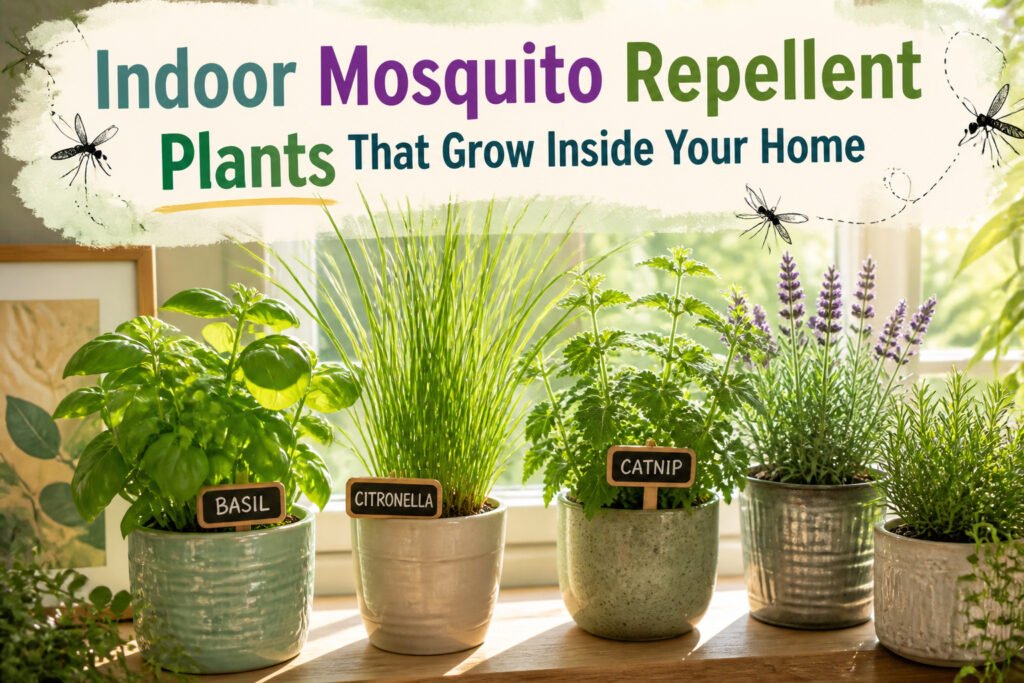
The difference between an indoor plant that repels mosquitoes and one that merely smells nice comes down to whether you are willing to bruise the leaves. Nepetalactone in catnip tests at roughly ten times the strength of DEET, but only once extracted; a living basil or citronella plant releases its oils only when crushed, cut, or brushed against. Without that friction, you have greenery, not a barrier.
1. Basil

Ocimum basilicum earns its spot on this list because the same volatile oils that make it worth growing, citronella, estragole, limonene, and nerolidol, are what mosquitoes find repulsive. The scent is pleasant to us; to them it scrambles the chemical signals they use to locate a meal. Crushing a leaf between your fingers before you set the pot down releases those oils in a concentrated burst, which is the quickest way to turn a kitchen windowsill into a small no-fly zone.
Not all basils carry the same punch. Lemon basil and cinnamon basil are the two varieties most often pointed to for enhanced repellent properties, though standard sweet basil still works. The difference is in the oil profiles; the lemon and cinnamon types layer citrus or spicy notes over the base aroma, and some growers find them more effective near doorways.
Last summer I kept a four-inch pot on a south-facing sill and watered it whenever the top of the soil looked dry. It wanted more light than it got. The stems stretched, the leaves stayed small, and the smell was thin. Basil needs six or more hours of bright direct sun to build the oils that actually do the repelling, plus moist, well-drained soil. Without both, you have a culinary herb, not a deterrent.
2. Citronella

Citronella grass, Cymbopogon nardus, is the plant behind every citronella candle and commercial repellent on the shelf. That name recognition makes it the first one most people buy, and the first one most people misunderstand.
The oil in the leaves is potent enough to register in EPA-approved sprays, but the living plant only releases it when the foliage is crushed or cut. A pot sitting on your windowsill does nothing on its own. I learned this after two weeks of watching mine do absolutely nothing while mosquitoes circled the room. The scent only arrived when I bruised a leaf between my fingers, and even then it filled the space fast, sharp and lemony, more industrial than I expected. Guests noticed within minutes, not all of them favorably. One asked if I was burning a cleaning product.
Hardiness zones 10–12 means it will not survive a frost, so in most of the country it moves indoors for winter or gets treated as an annual. It wants full sun and well-drained soil, and the clump grows large enough that a small balcony can feel crowded fast. I kept mine in the brightest south window I had and still watched it stretch thin, reaching for light it was not getting. The tropical texture is handsome, but the practical effect indoors is limited unless you are willing to crush leaves regularly and tolerate the smell that follows.
3. Lavender

Lavender (Lavandula spp.) carries the same essential oils that calm human nerves and send mosquitoes, moths, and flies looking elsewhere. The plant’s fragrance may even interfere with a mosquito’s ability to smell, which is why brushing against a leaf releases the strongest repellent effect.
Growing it indoors demands two things that are not negotiable: full sun and a pot that drains. I learned the second one the hard way. My first lavender sat in a decorative container with no hole, and I watered it on the same schedule as my basil. The roots rotted within three weeks. Lavender wants its soil to dry between drinks; once the roots are established, the plant is genuinely drought-tolerant, a trait that surprises most new growers who assume fragrant herbs need constant moisture.
For US readers, the zone question matters more for moving plants outdoors than for keeping them inside. English lavender varieties survive winters in USDA zones 5 through 9, Spanish types in zones 7–11, and some tender cultivars are grown as annuals anywhere colder. If you are buying for a windowsill and never plan to set it outside, any type works; choose by the size of your space and the quality of your grow light.
4. Rosemary

Rosemary, Salvia rosmarinus or the older Rosmarinus officinalis, is a woody perennial that can become a small indoor shrub if you have the light. The needle-like leaves carry volatile oils that mosquitoes, flies, and cabbage moths find overpowering, which is why the New York Botanical Garden and PlantShed both back it as a repellent. Six or more hours of direct sun is the threshold; anything less and the plant weakens and the oils thin out.
I learned this the hard way one February after moving a potted rosemary to a kitchen counter six feet from the south window. The stems went woody and half the needles browned from the tips inward. It was not a watering problem; the soil dried on schedule. It was simply too far from the glass. I cut it back hard that spring and the new growth came, but the lesson held.
The oil is easy to check. Crush a needle between thumb and forefinger and the scent should hit immediately, sharp and resinous. If you get only a faint, almost dusty smell, the plant is not producing enough to matter as a repellent. Move it closer to the light or replace it with a younger specimen started in brighter conditions.
5. Catnip

Catnip, or Nepeta cataria, carries one of the strongest research records among indoor mosquito repellent plants. Nepetalactone, the essential oil in its leaves, has tested at roughly ten times the repellent strength of DEET in controlled studies. The catch: that number applies to the concentrated oil, not the living plant sitting on your windowsill. A potted catnip still releases some aroma, but the oil extraction is what delivers the knockout punch.
My sister learned the other hard lesson about catnip the week she brought hers home. Her two cats shredded the leaves, knocked soil across the rug, and ignored every "deterrent" spray she tried. If you share space with cats, placement becomes the whole game: a hanging basket near a sunny window, or a room the pets never enter.
Catnip grows fast enough to become weedy in open ground, which makes containers the obvious move for indoor growing. Give it moist soil and a spot with sun to partial shade. In USDA zones 3–9 it behaves as a hardy perennial, though indoors you will treat it more like a renewable annual, cutting back leggy growth to keep the leaf production steady.
6. Mint

Mint, Mentha spp., carries a cooling fragrance that mosquitoes and some insects actively avoid. The genus covers peppermint, spearmint, and apple mint, all of which share that repellent quality. What separates mint from the drought-tolerant entries above is its need for moist, well-drained soil; let it dry out and the leaves crisp, overwater and the roots rot.
The invasive root system makes pots mandatory indoors. I learned this the hard way when my peppermint escaped a nursery pot with a crack I had not noticed and colonized a garden bed within a single season. Indoors, isolation is the rule: one plant per container, no shared soil.
Repellent oils sit in the leaves, released only when crushed. Rub a leaf between your fingers before placing it near a window or patio door. Between spearmint and peppermint, peppermint carries the stronger, more concentrated oil; spearmint is milder and sweeter, easier on the nose if you are sensitive. Both work, but peppermint edges ahead for mosquito use.
7. Marigolds

Tagetes carries a strong odor mosquitoes actively avoid, backed by six separate sources. That potency varies by type: African marigolds run taller and more pungent, while French marigolds stay compact and better fit a windowsill pot. The annual life cycle changes how you use them indoors compared to perennial options. I tried overwintering a potted marigold one November, cutting it back and moving it to the brightest south window. It limped along until January, then collapsed from leggy growth and root rot. Start fresh from seed or nursery pots each spring rather than fighting biology.
Full sun and average soil keep marigolds blooming from late spring straight through frost. They need that light to produce the volatile compounds that repel, so a dim apartment corner wastes the effort. Place the pot where you actually sit, near a patio door or balcony threshold, and the scent forms a low barrier without filling the whole room. Deadheading extends the bloom run, though the smell persists in the foliage either way.
8. Lemongrass

Cymbopogon citratus carries the same genus as citronella grass, which is why the lemon scent in your kitchen and the mosquito-repellent reputation share a root. The stalk is what gets harvested for cooking, but the oils that bother mosquitoes sit in the leaves, released most when you brush against them or cut for a stir-fry.
In my zone 7a garden, lemongrass stays outside until nights drop toward 40°F, usually mid-October, then moves to the brightest window I have. It is a tender perennial, so frost kills it outright, and the shift indoors always involves some leaf browning while the plant adjusts to the dry air. The Brooklyn Botanic Garden recommends lemon-scented plants like this one for keeping mosquitoes at bay, and the living plant outperforms any candle.
Six hours of bright, direct light daily is the minimum if you want the oils to stay potent. Without that intensity, the plant goes floppy and the scent fades to a whisper. I have killed one by guessing a north-facing window would do; it would not. A large container helps, since the clump-forming habit needs room, and the humidity it prefers indoors is the hardest part to replicate in heated winter air.
9. Eucalyptus

Eucalyptus brings more than 700 species to the table, and the oil of lemon eucalyptus in particular supplies compounds that show up in registered insect-repellent products. The living tree is not the same as a formulated spray, but the fragrance is real and mosquitoes do not seem to love it.
The catch is space. These are fast-growing trees, not modest houseplants, and indoors they want full sun plus humidity and airflow that most winter heating systems strip right out. I tried a young tree once in a dry apartment with forced-air heat and watched the leaf edges brown within weeks despite daily misting. Silver dollar eucalyptus stays smaller and more manageable in a pot than blue gum, which wants room you probably do not have. Even the compact kinds need a south window and some way to keep the air moving, a small fan or an open vent, or the foliage flags and the whole point of growing it fades.
10. Alliums

Allium spp. covers everything from garlic to chives to the ornamental onions with those globe-shaped purple blooms. The strappy leaves carry a mild onion scent when bruised, and that same sulfur-based chemistry is what confuses mosquito scent receptors. I keep a small chive pot on the kitchen sill mostly for clipping into eggs, and while the bruised leaves do release that sharp smell, the plant sits still most of the day. For any real effect against mosquitoes, you’d want to brush or crush the foliage periodically, which is easy enough when you’re already harvesting.
Dwarf varieties bred for containers exist, so a windowsill setup is workable even without a yard. Full sun and letting the soil dry between waterings keeps the roots healthy; soggy allium bulbs rot fast. USDA zones 3–9 covers nearly every indoor gardener in the country, though indoors you’re really managing light and drainage, not hardiness. The purple blooms are a side benefit in late spring, and some species reseed readily if you let the flower heads stay.
11. Floss Flower

Ageratum houstonianum, the floss flower, carries coumarin in its tissues, the same compound commercial repellents use against mosquitoes. I found mine by accident at a garden center, mistaking the label for a pollinator plant and only later learning why bees seemed less interested than I expected. The blooms run blue to violet, tight mounded clusters that read as annual bedding in most zones, though sources list hardiness only to 9–10 for year-round outdoor survival.
Indoors, the floss flower wants what it wants outside: part to full sun and soil that never fully dries. My own attempt stayed alive six weeks on a south windowsill before legginess set in, longer than some annuals manage but short of a permanent houseplant. The herb entries above have deeper documentation for indoor culture; with floss flower, you are working from a smaller shared record and adjusting as you go. Keep the moisture consistent and accept that you may be treating it as a seasonal visitor rather than a fixture.
12. Garlic

Allium sativum sits in the same genus as ornamental alliums, but the resemblance ends at the label. Garden garlic is grown for the bulb, not the purple pom-pom blooms, and its sulfur-heavy scent is what earns it a spot in companion planting rows. Farmers have long tucked it near roses to discourage aphids and Japanese beetles, and that same sharp profile suggests a supporting role against mosquitoes. It is not a replacement for repellent on your skin, though. The plant works at the margins, not the center.
Indoor growing is possible in containers, yet the conditions are specific. Garlic wants full sun and soil that drains fast; sit the pot in a window that gets six or more hours of direct light or the shoots stretch thin and weak. I once stuck a single clove on a north-facing sill in November, and by February I had a foot of pale, floppy greenery that smelled right but looked defeated. The bulb below never sized up. What I learned: garlic indoors needs the same fall planting schedule it gets outside. Set cloves in autumn, let the cool months establish roots, and harvest in late spring when the lower leaves yellow and dry. In USDA zones 4-9, this rhythm is straightforward. Inside, you are replicating that cycle with a pot deep enough for the developing bulb and light honest enough to prevent the leggy mistake I made.
What Works and What Does Not

A living room full of mosquito-repellent plants still let one in last August, which is the honest test of what these plants actually do. The aromatic compounds mosquitoes avoid, citronellal, geraniol, linalool and the rest, release in meaningful amounts only when you brush against leaves, crush them, or work with cuttings. A plant sitting quietly on a shelf behaves nothing like a bottle of concentrated essential oil. Whole plants are not a complete mosquito-control system, and anyone promising otherwise is selling a story.
The practical approach treats them as one layer among several. Screens on windows, a fan moving air across where you sit, and dumping any standing water in saucers or trays do more actual bite prevention than greenery alone. Place these plants where you pass close enough to disturb the foliage, near a reading chair or by the door you open to the balcony, so the oils release where you need them. Last summer I ran a small fan across my plant shelf and caught fewer bites than the year before when I relied on the greenery by itself. The plants help. They do not replace the basics.
Light and Soil for Indoor Growing

The chemical compounds that repel insects are produced in the leaves, which means six hours of bright, direct sunlight daily is not a suggestion; it is the minimum for the plant to actually do its job. On a windowsill, that usually means a south- or west-facing exposure with no overhang or tree blocking the glass. In winter, or in a room where the best window catches morning shade and afternoon gloom, a grow light becomes necessary. I run mine on a timer for eight to ten hours to cover the gap, because weak, leggy herbs smell weak too.
Soil matters as much as light. The mix I use is one-third perlite, one-third potting mix, and one-third compost. That drains fast enough for lavender and rosemary, which rot in anything heavier, yet holds enough moisture for basil, which wants steady dampness. Most of these plants are annuals or tender perennials rated for zones 9–11, so if you summer them outside, bring them in before nights drop below 50°F. I harden mine off over a week: two days in full shade, two in partial sun, then full sun before they come indoors, reversed on the way back out in spring. Skip that step and the leaves yellow, the oils thin, and you have a decorative plant that does not repel anything.
Where to Place Them

Indoor mosquito repellent plants work best when you treat them like living air fresheners rather than perimeter guards. Their oils only travel a short distance, so impact stays concentrated near the plant itself and fades fast in larger rooms. I learned this the hard way after parking a pot of citronella across a twelve-foot living room and wondering why mosquitoes still found my arm.
The trick is placing them where you actually sit or stand. My kitchen counter holds basil and mint, since crushing a leaf while I chop releases the volatile oils right where I work. Upstairs, lavender and rosemary sit on the bedroom windowsill; both prefer drier air than the bathroom or kitchen provide, and the south-facing glass gives rosemary the bright light it needs to keep producing those sharp oils.
Think of it as companion planting adapted for rooms. Cluster the herbs where people gather, not where they look prettiest. A pot by the door reads well in photos, but a pot by your reading chair does the actual work.
Frequently Asked Questions
Do mosquito-repellent plants really work?
Yes, but they are not a complete mosquito-control system. The aromatic compounds in these plants release in meaningful amounts only when you brush against leaves or crush them; a plant sitting quietly on a shelf does far less than concentrated essential oil. For real bite prevention, combine them with screens, fans, and removing standing water.
What are the best plants to keep mosquitoes away?
Basil, citronella, lavender, rosemary, and catnip are among the strongest options for indoor growing. Lemon basil and cinnamon basil carry extra punch, while catnip’s nepetalactone has tested at roughly ten times the repellent strength of DEET in oil form. Each needs bright light and proper care to produce the oils that actually repel.
How do I use plants to repel mosquitoes?
Place them where you sit or stand, then crush or brush the leaves to release the oils. A pot by your reading chair or kitchen counter works better than one across the room, since the scent only travels a short distance. Run a small fan across the foliage to help disperse the volatile compounds where you need them.