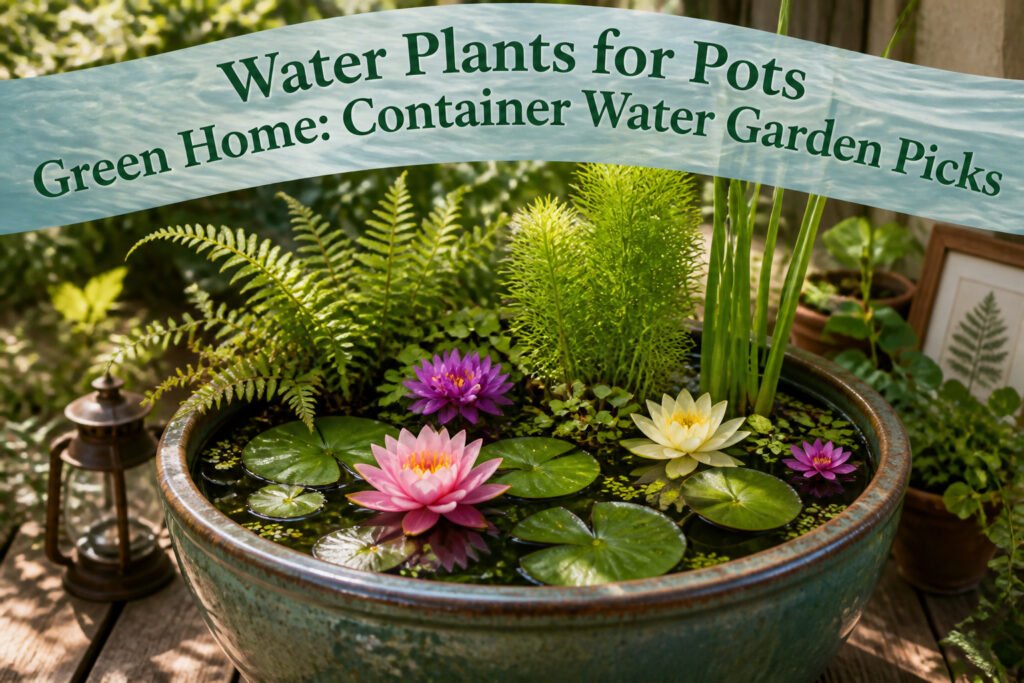
A container water garden is a planted pot or patio vessel that holds standing water year-round, letting you grow aquatic species without digging a pond. The catch is that depth matters more than width: anything shallower than 12 inches restricts you to a handful of small plants and heats up fast enough to stress everything submerged. Aim for at least 18 inches, and seal those drainage holes with waterproof tape or caulk before you fill it.
Water Lettuce

Water lettuce, Pistia stratiotes, spreads across the surface in soft, velvety rosettes that look like loose-leaf lettuce heads left to float. Beneath each one, long feathery roots trail down, sheltering small creatures and pulling nutrients from the water. That shading is what keeps algae from taking over; six sources back this plant as a top choice for container water gardens precisely because it cuts the sunlight that fuels green water.
In a pot or patio container, the growth habit works in your favor. Each rosette sends out shoots to make more, and thinning them by hand is all the control you need. It stays manageable where space is limited, and it handles the shallows well. The same trait turns invasive in frost-free climates, where water lettuce chokes waterways year-round. Zones 9–11 are the watch zone; treat it as an annual anywhere winters freeze, and never release it into ponds or streams where it could survive.
Water Hyacinth

Eichhornia crassipes, the water hyacinth, floats with spoon-shaped leaves and bulbous stems that keep it riding the surface. Lavender flowers spike up about six inches, and the feathery root system shelters small water creatures while pulling nutrients from the water. In a contained pot on a patio, it reads as the finishing touch, softening hard edges the way a few scattered floaters complete a larger planting.
The same vigor that makes it indispensable in controlled setups is why several states flag it invasive. Left open to ponds or waterways, it spreads fast enough to choke native habitat. That legal status matters for a balcony gardener: some retailers will not ship it, and a few states ban possession outright. The ethical split runs right through the water-gardening community. One side sees a living filter and easy color; the other sees a plant that escapes through dumped contents or split containers and never quite gets recalled.
I keep it only in closed pots, never in ground-level dishes that overflow into drains, and I thin it before it crowds the surface. Zones 9–11 suit it best, though a warm summer anywhere gives a season of growth. Full sun to partial shade keeps the flowers coming. If your state restricts it, water lettuce fills a similar visual role without the same red tape, though it lacks the hyacinth’s filtering punch.
Water Lily

Nymphaea is the plant most people picture first when they imagine a water garden, and for good reason. Those wide floating leaves and summer blooms turn a plain pot into a focal point. I have seen ‘Perry’s Baby Red’ recommended for containers: dark green foliage, wine-red cup-shaped flowers, and a planting depth of 6 to 18 inches. Other Nymphaea varieties ask for 12 to 24 inches, so check the depth before you buy the pot, not after.
Aquatic soil matters here. Standard potting mix floats apart and clouds the water; sources suggest using nonorganically amended clay soil instead, with fertilizer tablets from a water-garden supplier. The visual payoff comes once the leaves spread to cover surface area, which also shades out algae. In a container, that dual role, beauty and function, is what justifies the extra soil prep.
Miniature Cattail

Typha minima carries its height like a narrow exclamation point above the waterline, topping out around 30 inches where standard cattails would push past six feet and block your patio view entirely. I keep mine in a 14-inch bowl set to a planting depth of 1 to 4 inches, the shallow margin where dwarf cattails naturally settle in pond edges across Europe and Asia. The linear leaves stay tidy, and the small dark brown spikes that appear in summer read as texture rather than takeover.
That vertical habit solves a real container problem. Most water-garden plants either float flat or sprawl; miniature cattail gives you a back-of-the-pot focal point without the mass that would tip a small setup in wind. It fills the marginal zone, that shelf between deep water and dry land, in a way that reads deliberate even in a pot barely larger than a dishpan. On my own balcony, the full-sized species would have sent roots through any barrier I set and shaded everything below it by July. The compact form stays where I put it, and the narrow footprint leaves room for something lower at the front edge.
Dwarf Papyrus

Cyperus isocladus, the dwarf papyrus, sends up stiff green stalks topped with feathery heads that catch the light like miniature fireworks frozen mid-burst. In a container water garden, that vertical silhouette does the work of a small reed bed without the sprawling footprint, and the texture reads as airy rather than heavy even when the plant is fully mature. I have seen it used as a single accent in a 14-inch pot and packed three to a window box set into shallow water; both times it held its shape without flopping.
The species handles wet feet better than almost any beginner-friendly choice, which matters when you are still learning how much water stays too much water. Constant moisture is not a stressor for this plant but its baseline condition. Full sun will keep the stalks shortest and the heads tightest, though a little shade in the hottest afternoon stretches the season without much loss of form. In zones 8 through 10 it overwinters in place; farther north it functions as an annual unless you have space to bring the pot indoors to a bright, humid spot.
What surprised me, reading the care notes, was how contentedly pot-bound dwarf papyrus grows. The roots will circle and thicken rather than sulk, and the congestion seems to encourage more stalks rather than fewer. Repot only when water uptake slows visibly, not on a calendar schedule. That tolerance for cramped quarters makes it an easy companion in mixed containers where other water plants for pots green home setups demand more root room and more fuss.
Pickerel Plant

Pontederia cordata, the pickerel plant, grows vertically out of the water with leaves that bridge the gap between surface and air, a habit that reads as drama in a small container. The spikes of densely packed blue to purple flowers run for a good stretch of summer, and the pollinators find them without any prompting. What sold me on keeping one was the hardiness: Zone 3–8 means it survives winters that would turn tropical water hyacinths to mush, so gardeners in cooler climates do not have to restart each spring. Height runs 24 to 30 inches in full sun to part shade, enough to give a small pot real presence without shading out shorter neighbors beneath it. Native to North American marshes, it handles the shallows of a container water garden the same way it handles a pond edge, and surface-feeding waterfowl will take the seeds if you set the pot where they can reach.
Duckweed

Duckweed, Lemna minor, spreads across still water so fast it can feel like a magic trick the first time you see it. That same speed is why some growers love it and others curse it. The bright green mat shades the surface, which blocks the sunlight algae need, so the water stays clearer without chemicals. In a patio pot, that means almost zero maintenance: no planting depth to fuss over, no soil to anchor.
The catch is the same density that suppresses algae can starve submerged plants of light and gas exchange. I thin mine by scooping out handfuls every couple of weeks and tossing them under shrubs as green mulch, or into the compost. The Illinois Extension notes aquatic floaters grow rapidly when fertilizer is present, so a crowded pot is a warning to pull some out, not feed more.
Some states list duckweed as a nuisance, and the advice on disposing of water garden plants is firm: never dump into drains or natural waterways where it can choke native systems. In a contained pot on a balcony, that risk is yours to control. The division is simple: if you check the pot weekly and remove excess, duckweed is a free, living shade cloth; if you travel for weeks at a stretch, it will own the container by the time you return.
Anacharis

Egeria densa, sold in most shops simply as anacharis, grows entirely below the surface, which sets it apart from the water lilies and floaters that steal the visual attention. Its job is to pull nutrients from the water column and release oxygen directly into it, a process that keeps the pot’s chemistry steadier and the water clearer than surface cover alone can manage. I learned the hard way that a container with only floating plants turns cloudy fast; the submerged growth fills in where surface shade cannot reach.
If you add small fish to your container, anacharis becomes nearly essential. Fish draw oxygen from the water itself, especially overnight when plants stop photosynthesizing, and a dense bunch of anacharis offsets what surface plants take back. Most retailers sell it weighted in loose bunches rather than potted, which makes placement simple: drop it to the bottom and let it root or drift.
Strive for a balanced selection of water plants—e.g., floating leaf aquatics, oxygenating grasses, bog, and marginal water plant species. Four to five plants can fill a pot that has a 16" diameter and is about 12" deep.
— National Wildlife Federation
That mix matters more than any single plant. Anacharis handles the underwater work so your floaters and marginals can handle the surface and the edges without the water going sour between them.
Hornwort

Ceratophyllum demersum, or hornwort, drifts through the water column without ever rooting into soil. I keep it weighted just below the surface with a small stone or a lead-free sinker, and it stays there, free-floating and fully submerged, pulling nutrients straight from the water. That habit makes it an oxygenator that starves algae of the very same nutrients, and it does the job without any planting medium to cloud the pot.
Hornwort runs hardy across a wide spread of zones, so most household gardeners will not need to fuss over whether it survives their winter. The texture sets it apart from anacharis: hornwort’s foliage is denser, more forked and feathered, almost like soft bottle brushes drifting loose, where anacharis carries smoother, more ribbon-like whorls. Growth stays slower and more controlled, too. In my own containers, anacharis can shoot up and tangle within a season; hornwort thickens gradually and trims back neatly when it crowds the space.
Fairy Moss

Azolla filiculoides, commonly called fairy moss, is a tiny floating fern that shifts from bright green in spring to a rusty copper by late summer. That color change alone sets it apart from the uniform green carpet of duckweed, though both plants behave similarly on the water’s surface. Like legumes in soil, fairy moss fixes nitrogen from the air into the water, which can reduce the need for supplemental feeding of other container plants over a season.
The plant spreads quickly into a dense mat, sometimes thick enough to block light below. In a small pot or half-barrel, that coverage can turn from asset to problem within weeks, and thinning becomes regular maintenance through July and August. A thin scattering in spring usually thickens to full cover by June, which is the rhythm to plan around.
Despite these useful traits, fairy moss remains harder to find at garden centers than duckweed. Part of that scarcity comes down to handling; the fronds are fragile and dry out in minutes out of water, so shipping and shelf life are limited. Most growers I have asked either propagate their own or swap with other water gardeners in early spring when the green growth is easiest to establish.
Container and Depth

A container water garden starts with something that actually holds water, which sounds obvious until you realize how many pots have drainage holes. Those holes need sealing with waterproof tape, caulk, or patching material, depending on their size, and some trial and error is usually involved to find what sticks.
Depth matters more than width. Aim for at least 12 inches deep, though 18 inches opens up far more plant choices. A 5-gallon minimum volume gives roots room and keeps temperature swings moderate. The containers commonly sold for this sit around 24 inches across with that 12–18 inch depth range, which I’ve found to be a workable sweet spot for a small setup.
Wood and metal containers need liners, no exceptions. Wood leaks and can leach chemicals into the water; metal rusts. Half barrels, at 24 inches wide by 16 inches deep, are a classic choice but only after you drop in a fitted plastic liner or double-layer flexible PVC if the material is 10 millimeters or thinner. Single-layer thin PVC gives out in a year or two.
Too-shallow pots restrict you to a handful of small plants and heat up fast in summer sun, which stresses anything submerged. Go shallower than 12 inches and you’re essentially growing in a birdbath, not a garden.
Soil That Stays Put

Aquatic soil is usually made up of kiln-fired clay particles, and that density is exactly what keeps it from drifting. Never use potting soil in a container water garden; the organics in it float, and within a day the water turns cloudy with debris that never fully settles. Clay soil works well too, though too heavy a concentration can choke root growth, so I look for a mix that includes some sand and peat rather than straight clay. The first year I tried this, I used bagged potting mix because it was what I had on hand. The water looked like weak coffee for a week, and when I finally fished the pots out, the soil had broken apart and half the roots were bare. I repacked everything with aquatic soil from a pond shop, packed it tight the way you are supposed to, and the difference was immediate. Gravel on top helps weigh lighter soil down, but gravel alone has no nutrients, so I only use it as a cap, not a base. You can buy aquatic soil premixed or blend your own from clay, sand, and peat; either way, the test is whether it stays put when you submerge the pot.
Three Kinds of Plants

A balanced container water garden needs three kinds of plants working together. Floating plants like water lettuce shade the surface and cut algae growth. Submerged plants, sometimes called oxygenating grasses, keep the pH steady and the water clear; anacharis and fanwort are the usual choices. Marginal plants sit at the bottom with their roots barely covered, mimicking the marsh edge where they’d grow naturally. Horsetail is one that handles this zone well.
Four to five plants fill a 16-inch pot about 12 inches deep. The mix matters more than the count. Without floaters, sunlight breeds algae. Without submerged growth, the water turns stagnant. Without marginals, the arrangement looks like a tub of weeds. Illinois Extension notes that aquatic plants grow fast, so starting spare beats crowding; thin the floaters and compost the excess before they choke the others. Smart-pond adds that dwarf or compact varieties suit small setups best, and checking local guidelines keeps invasive species out of the equation.
Water and Light

Rainwater fills the pot best, though most of us end up running the hose. Tap water carries chlorine that can burn tender roots, so I set a bucket out for 24 hours before it goes into the container. That wait lets the chlorine off-gas; some sources suggest a full two days if your municipal supply runs heavy on treatment.
Light sits in the same balancing act. Six hours of direct sun keeps water plants for pots green home setups growing, but push past that and algae takes the invitation. In my own spot, morning sun hits the pot by eight and shade slides over by two. That timing has kept the water clear enough that I can still see the soil line.
Evaporation pulls water down fast in summer, and topping off with fresh chlorine-heavy tap undoes the waiting you did. I change out 10–20% of the volume weekly instead, using that aged bucket water. The partial swap clears out the waste that accumulates without shocking the roots with a full refill.
Arranging at Depth

- Bricks or upside-down clay pots set under the plant container raise a marginal so its crown sits 6 inches or less beneath the surface, which is where most of them actually grow.
- One flat bottom fails because different plants want different depths; a canna in a six-inch nursery pot dropped into a 24-inch vessel will drown, while the same pot perched on a brick brings the crown up to where it can breathe.
- Plastic pots will float and shift, so clay is the better choice for the pedestal itself.
- This stacks the container the same way a natural pond shelves from deep center to shallow margin, letting you place tall, spiky plants behind and broad-leaved or cascading forms forward without everything fighting for the same waterline.
- The arrangement stays flexible: lift a pot, swap a brick height, and a plant that outgrows its depth gets a new level without repotting.
Frequently Asked Questions
What plants can I grow in a container water garden?
Water lettuce, water hyacinth, water lily, miniature cattail, dwarf papyrus, pickerel plant, duckweed, anacharis, hornwort, and fairy moss all work in container setups. A balanced mix needs floating plants to shade the surface, submerged plants to oxygenate the water, and marginal plants for structure at the edges. Four to five plants fill a 16-inch pot about 12 inches deep.
How deep should a container water garden be?
Aim for at least 12 inches deep, though 18 inches opens up more plant choices. A 5-gallon minimum volume keeps temperature swings moderate and gives roots room. Anything shallower than 12 inches essentially functions as a birdbath, heating up fast in summer sun and restricting plant options.
How do I prevent algae in my water garden?
Let floating plants cover the surface to block the sunlight algae need. Water lettuce, duckweed, and fairy moss all shade aggressively, and their root systems pull nutrients from the water that would otherwise feed green water. Six hours of direct sun is the ceiling; push past that and algae takes the invitation regardless of plant cover.
Can I use tap water for my water garden?
Yes, but let it sit for 24 hours first so the chlorine can off-gas. Rainwater fills the pot best, though most gardeners end up running the hose. Top off with aged water rather than fresh tap, and swap out 10–20% of the volume weekly to clear accumulated waste without shocking the roots.