
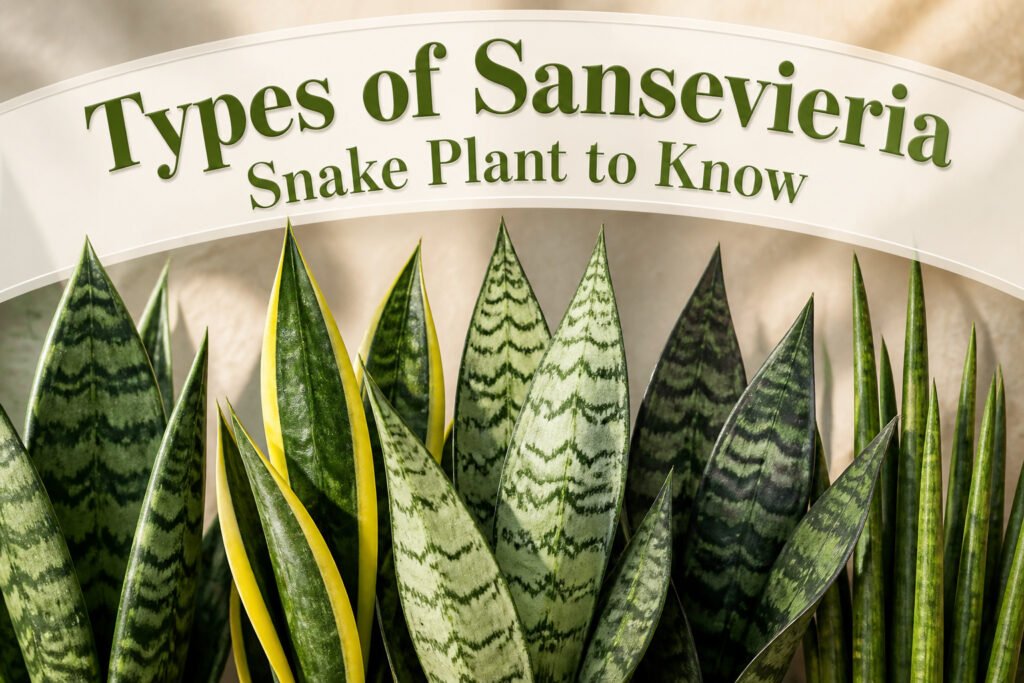
Snake plants range from 6-inch rosettes to 6-foot spears, and the difference that matters is not size but how the leaves carry their color. Most variegation fades toward plain green in low light, yet a few varieties like ‘Black Coral’ actually sharpen their contrast in dim corners, turning silvery bands into readable texture where others go dull. The ‘Laurentii’ yellow edge you paid for will revert to green within weeks of a dark hallway, while ‘Zeylanica’ keeps its forked stripes without a window at all.
1. Sansevieria trifasciata ‘Laurentii’

Tall, upright leaves with yellow edges running their full length make Sansevieria trifasciata ‘Laurentii’ the variety most people picture when they hear "snake plant." The dark green center carries lighter green horizontal banding, and the whole plant reaches 3 to 4 feet, giving it real presence in a corner or beside furniture.
The margins stay consistent only in bright light. In lower light, that gold edging fades toward green, and the plant reverts toward the plain species look. Mine sits near an east-facing window where it gets direct morning sun for about two hours; the yellow has held steady there for three years.
This was the first snake plant I bought, chosen mostly because it was the one the nursery had in quantity and I recognized it. Two months after bringing it home, I moved it to a dark hallway while repainting the living room. It sat there with no window at all, watered once in that stretch, and pushed out a single slow leaf that was noticeably narrower and paler than the rest. Once it came back to the window, the next leaf returned to normal width and color. That tolerance for abuse is why it still gets recommended to beginners, though the color you bought it for needs the light to stick around.
2. Sansevieria trifasciata ‘Zeylanica’

The wavy, lighter green stripes on dark green leaves set ‘Zeylanica’ apart from the more regular banding you see on ‘Laurentii’ or ‘Black Gold’. Where those varieties keep tidy horizontal lines, this one looks like someone dragged a fork through wet paint. The edges stay rough and brown most of the time, giving it a worn-in, almost ragged look that reads as character rather than damage.
Minor leaf cracking is normal on this plant. I have learned not to panic when a thin line appears mid-leaf; it does not mean rot or thirst, just the cost of those stiff, fibrous leaves doing their job. The real thirst signal sits in the leaf shape itself. When water runs low, the edges curl slightly inward, a subtle buckle that shows up before any color change or droop. Catching that curl early prevents the deeper stress cracks that harder neglect can bring.
Reaching 2–3 feet at maturity, ‘Zeylanica’ grows more slowly than some of the common snake plants. The payoff is resilience. Shade tolerance runs higher here than in many varieties, and the lack of yellow margins means no fading when light stays dim. For a dim patio corner or a north-facing balcony where ‘Laurentii’ would lose its gold edge and sulk, this is the harder-working choice.
3. Sansevieria trifasciata ‘Moonshine’

Broad, silvery-green leaves give ‘Moonshine’ its other name, the silver snake plant, though that color is conditional on light. The leaves come in almost white when new, then settle into a cool silvery-gray with faint vertical bands and narrow darker edges. Keep it in bright, indirect light or the silver drains away fast. Shadier spots push the foliage toward a darker green, and the margins thicken in color until the whole leaf looks like a different cultivar entirely.
My oldest leaf turned almost jade after one winter parked too close to a north window. I had not moved the pot; the season moved the sun, and by March the leaf was dark enough that I double-checked the nursery tag. Two feet is the mature height on these, with a slightly shorter, wider build than the Laurentii types. The new growth still carried that pale, moonlit tone, but only on the side facing the glass.
4. Sansevieria trifasciata ‘Black Gold’

The ‘Black Gold’ snake plant carries dark green leaves so deep they read almost black under low light, each one banded with bright golden-yellow margins thicker and more saturated than what you see on the familiar Laurentii. That extra weight of color gives it a formal look, almost like a plant wearing trim, and the upright swords stay compact enough for a desk or a narrow shelf. Mine took its time. The plain green trifasciata I started the same season had already pushed two new leaves and a pup while the ‘Black Gold’ sat there, rootbound and apparently content. Growth height tops out around 2–3 feet, less ambitious than other trifasciata cultivars, and the young leaves come in rounded and short before lengthening as they mature. The wait, though, bought me color that did not fade even in the dim corner of a north-facing bedroom where a cheaper variegation would have washed back to green. If a leaf scars or breaks, a clean cut with a sterilized blade restores the pointed silhouette. The slower metabolism also means it asks for water less often, which suits the forgetful schedule of most beginner growers. In my collection, this is the one guests ask about first.
5. Sansevieria trifasciata ‘Bantel’s Sensation’

The narrow leaves of Sansevieria trifasciata ‘Bantel’s Sensation’ stand upright like blades of grass someone painted with white ink, each stripe running the full length without fading. Where most snake plants spread broad, almost waxy leaves to catch whatever light filters through a room, this one keeps a slender profile that reads as delicate even though the plant itself is just as stubbornly alive as its cousins. Gustav Bantel discovered this variant, and the refinement shows in the growth habit: slower to fill a pot, slower to make offsets you can divide, so patience matters more here.
The striping stays crisp only with slightly brighter light than the broad-leaf varieties tolerate. In a dim corner the white fades toward cream, then green, and the whole point of choosing this cultivar over a standard trifasciata disappears. I keep mine where it gets a few hours of direct morning sun through an east window, and the contrast has held for two years now. At three feet mature height it stays manageable on a small patio or a narrow shelf, though the vertical lines draw the eye upward in a way wider leaves never quite manage.
6. Sansevieria masoniana ‘Whale Fin’

A single, paddle-shaped leaf rising from a small pot is exactly how Sansevieria masoniana ‘Whale Fin’ arrives at most nurseries. That is not a stunted plant waiting to fill out; it is the normal growth habit. Each growth point pushes up one leaf at a time, broad and upright, reaching 3–4 feet tall and up to 10 inches wide with dark green mottling and a thin red or orange edge along the margin.
New leaves emerge from beneath the soil line, gradually unfolding to join the existing foliage. At the start, you may only see one or two leaves a year while the plant establishes its root system. The wait between leaves is long enough that the single-leaf stage can persist for seasons, which catches buyers off guard if they expect the clustered rosette typical of other snake plants.
The leaf is thick and heavy, and a mature one carries enough weight that the whole pot becomes top-heavy. Mine sits in a heavy ceramic pot for exactly this reason: a lightweight container tips easily once the leaf gains height, and a fall will crack the foliage or snap it at the base. A wide, low vessel with some heft to it keeps the plant upright through normal bumps and watering shifts.
7. Sansevieria cylindrica

Sansevieria cylindrica carries its leaves like upright spears, round and stiff, pointing skyward from the base without any stem to speak of. That geometry is what drew me to it, though the plant I brought home had already been shaped further: six young leaves braided together into a neat plait, a nursery technique that takes advantage of how flexible the new growth still is.
The African spear plant is a slow-growing succulent prized for its long, round stemless leaves which arch outward from its central crown. There’s also a straighter cultivar, whose leaves stand upright to attention. Mature size: 6 feet.
The 6-foot mature size matters because those braids do not hold. As each cylinder thickens and ridges, the tension builds; the leaves either snap or force the braid apart. New growth from the soil line comes up untrained, so the architectural shape gets surrounded by random upright shoots regardless.
On whether to unbraid my own plant, I left it. The leaves stiffen to the point that bending them risks breaking them outright, and a snapped leaf is a worse look than a loosening plait. Let the braid loosen naturally and cut the new growth back to the base if you want to keep the clean shape; trying to retrain mature leaves is not worth the damage.
8. Sansevieria ‘Starfish’

Short, tubular leaves fan out from the base in a star shape that reads as sculptural rather than spiky. Mine stayed the same size for a solid year before it finally pushed a second fan, which is the pace you should expect. The growth habit differs from regular cylindrica in both scale and direction: cylindrica runs upright and taller, while ‘Starfish’ stays compact and low, spreading radially instead of vertically. That makes it one of the few snake plants that actually works on a small shelf without eventually knocking over your mug. Mature height lands around 1 foot, with dark green leaves banded in light grayish-green. The silvery tone catches window light and gives the plant a slightly metallic look that photographs well against white walls. Slow growth is the tradeoff for a shape this distinct, so buy the size you want to see for a while.
9. Sansevieria ‘Fernwood Mikado’

Sansevieria ‘Fernwood Mikado’ carries a hybrid background, a cross between D. parva and D. suffruticosa, though garden centers still file it under the old Sansevieria name. The leaves grow slender and arching, more grass than sword, cylindrical like the Starfish variety but thinner, with obvious vertical grooves running their length. Dark green fills the base, streaked with lighter green horizontal bands and a zigzag pattern that catches light differently than the flat blades most people picture when they hear "snake plant."
Where a standard Sansevieria trifasciata stands at attention, the Fernwood Mikado bends. That relaxed posture matters when placing it: the foliage stays dense and upright enough for a floor pot, but the arching tips soften edges in a way rigid varieties do not. I have seen it work best where the viewer passes close, on a side table or low shelf, because the grassy texture reads as something else entirely from across the room. Mature plants top out around 3 feet, shorter and denser than D. bacularis, which it otherwise resembles. The compact habit suits tight corners, though some growers report specimens pushing 6 feet in ideal conditions. Either way, the modern, almost sculptural silhouette pairs cleanly with simple planters, and the same drought tolerance that runs through the genus holds here. Well-draining soil and neglect keep it alive; bright indirect light keeps the markings crisp.
10. Sansevieria francisii

Sansevieria francisii stopped me cold the first time I saw it at a nursery in Phoenix. The leaves stack in tight, distinct tiers up a central stem, each row slightly offset from the one below, and I spent a solid minute trying to place what family it even belonged to. The growth habit reads more like a miniature agave or some odd succulent than any snake plant I had handled before.
Each tier holds a cluster of short, tubular leaves, stiff and pointed, marked with faint grayish-green horizontal stripes and ending in brownish tips. The leaves themselves stay small, around six inches, but the stem keeps adding layers and can reach up to 2 feet over time. That tiered look does not arrive overnight. The plant puts out a few stacked rows, then sits apparently doing nothing while it builds the next set. I have had mine for three years, and only in the second year did the vertical stacking become obvious enough to read as the plant’s signature shape.
Light decides whether it stands or trails. In bright conditions, the stem stays upright and the tiers climb. In lower light, the weight of those leaf clusters eventually pulls the stem outward, and the plant starts to lean or cascade. I keep mine in an east window where it gets direct morning sun; the stem has stayed vertical and the spacing between tiers has stayed tight. A friend growing the same plant in a north-facing apartment has hers trailing over a shelf edge, which works if you want that look but reads as a different plant entirely.
The patience is real, and worth it if the architectural shape appeals to you. This is not the snake plant you buy for instant gratification.
11. Sansevieria ‘Hahnii’

Sansevieria ‘Hahnii’ grows in a tight, low rosette that spreads outward rather than upward, which is why the common name bird’s nest snake plant fits. Mature height sits around six to eight inches, with some sources listing it as high as 1.5 feet; either way, it stays compact enough for a shallow dish garden or a narrow windowsill where a standard snake plant would hit the glass.
Offsets emerge from the base and gradually fill whatever container you give them. In my experience, a four-inch pot turns crowded within a single growing season, and the whole clump starts to look more like a ground cover than an upright houseplant. That growth habit changes how I water it. The leaves are thicker and more water-retentive than they look, so I let the soil dry almost to the bottom of the pot between waterings, closer to how I treat a small succulent than a leafy tropical. Root rot from overwatering is the main way I’ve lost offsets.
12. Sansevieria ‘Jaboa’

Sansevieria ‘Jaboa’ carries leaves thick enough to feel like you’re lifting a small dumbbell when you repot it. The variegation runs creamy rather than the sharp white you see on Bantel’s Sensation, more butter-yellow along those wavy horizontal bands against the deep green. I had mine in a 6-inch nursery pot and within eight months the rhizome had warped the plastic so badly I had to cut it away. A 10-inch terracotta with a mix heavy on pumice became the next stop faster than I expected for a snake plant. Mature height lands around 24 to 30 inches, and the leaf width means it wants floor space, not a windowsill. Big-box stock is spotty; I found mine at a local nursery for roughly $100, though a friend pulled a large specimen from Home Depot under $50, so timing and region matter more than rarity.
13. Sansevieria ‘Black Coral’

Deep green leaves with wavy horizontal bands of lighter green set ‘Black Coral’ apart from the flatter varieties. The waviness is the giveaway, not just the color. I keep mine in a north-facing bedroom where the banding stays soft and silvery-green; move it closer to a window and those same bands sharpen to almost gray, a shift that happens over weeks, not days. That responsiveness makes it, in my view, the most underrated variety for low-light rooms. Most snake plants tolerate dim corners, but this one actually looks interesting there, the lighter bands catching what little light exists and keeping the leaf from reading as a solid dark slab. The plant reaches about 3 feet at maturity, similar in height to Laurentii, so it fills vertical space without the yellow margin that can clash with cooler palettes. I passed on a specimen at a local nursery once, too bulky to carry home and priced higher than the common types; the smaller ones I have now came from a standard garden center and grew into that same upright form within two seasons.
14. Sansevieria ‘Futura Superba’

Sansevieria ‘Futura Superba’ tops out around 15 inches, a full head shorter than the Laurentii most people picture when they hear snake plant. That difference matters when you are working with a desk, a bathroom ledge, or a side table where vertical space runs tight. The growth habit stays neat, too: three to five broad leaves per plant, upright at first then gradually arching back as they age, forming a contained rosette that reads fuller at the base than the taller trifasciata forms.
The leaf proportion is what sold me on this one for small spots. Where standard snake plants stretch narrow and tall, Futura Superba carries width across shorter length, so the silhouette stays balanced even in a 6-inch pot. The grey-green center banded with lighter and darker tones, edged in that substantial yellow margin, gives the same graphic punch without the eventual topple of a 3-foot column in a windy corner or a cat-prone windowsill.
I keep mine on a narrow console where a Laurentii would already be brushing the underside of a shelf. It handles the same neglect, the same irregular watering, the same range of light conditions, but the footprint stays predictable. For a balcony or a first apartment with thrifted furniture and no floor space to spare, that predictability is the point.
15. Sansevieria ‘Whitney’

Sansevieria ‘Whitney’ fills the same compact footprint as ‘Hahnii’ but grows upright instead of in a tight rosette, which changes where it actually fits on a shelf or windowsill. The leaves read as nearly solid dark green from across a room; the variegation is that subtle. Move closer and you catch the silvery-green edges and the faint light green crossbanding running through each leaf. That near-solid quality makes it the variety to place where side-light grazes the foliage, because the stripes only announce themselves when the angle catches them. I keep mine on an east-facing sill where morning light slides across the leaves, and the banding shows up for an hour or two before flattening back into green. At about 12–15 inches mature height, it stays small enough for a desk or a narrow ledge without the outward spread that rosette types need.
Watering and Light for All Varieties

The care rules stay the same no matter which types of sansevieria snake plant you bring home. Thick, fleshy leaves store water like a cactus, so the soil needs to dry completely between drinks. In spring and summer, that usually means watering every two to three weeks, but fall and winter demand a harder pullback. Once a month is plenty then, or simply wait until the pot feels light and the surface looks dusty.
My first Sansevieria cylindrica taught me this the wet way. I watered it on the same weekly schedule as my pothos, and the base turned soft and yellow within a month. Root rot had already set in by the time I noticed. Now I check dryness with a plain wooden skewer from the kitchen drawer, pushing it deep and pulling it out to feel for any clinging dampness. Only water when the skewer comes back dry to the tip.
Light follows a similar pattern across varieties. A snake plant will survive in a dim corner, which is part of their appeal, but growth stalls to nearly nothing and the color goes dull. Bright, indirect light is where they actually thrive, especially the varieties with lighter or variegated leaves that need more energy to keep their patterns crisp. Direct hot sun will burn those succulent leaves, so a few feet back from a south or west window works better than pressed against the glass.
Propagation That Actually Works

Snake plants propagate in two ways, and only one of them keeps the looks you paid for. Division is the reliable path: lift the plant, split the rhizomes, and each section carries its full genetic code forward. I divide my ‘Laurentii’ this way because the yellow edge bands disappear entirely in leaf cuttings, leaving you with plain green growth indistinguishable from ‘Zeylanica’. Leaf cuttings do root, but the wait is real. Cut a healthy leaf into two- or three-inch sections, let the ends callous for a day or two, then stand them upright in moist, well-draining soil. Roots can take months, and the single biggest mistake is pulling them up to check. I have killed more cuttings through impatience than through any actual failure to root.
Air Quality and Toxicity

The air-purifying reputation of snake plants is real but smaller than the marketing suggests. A single Sansevieria in the corner of a room will not meaningfully clean the air you breathe. The NASA study that started this conversation used sealed chambers and hundreds of plants, and your living room is neither sealed nor stocked like a greenhouse. I keep mine because they survive low light and neglect, not because they are functioning air filters.
The pet toxicity, on the other hand, is not overstated. Saponins in the leaves cause vomiting, diarrhea, drooling, and lethargy in cats and dogs. Keep them where a curious mouth cannot reach. My snake plants sit on a high shelf in the office, a room the cat rarely enters, and behind a closed door the rest of the time. That arrangement failed once: my dog found a leaf tip that had snapped off during watering, chewed it, and spent the next hour drooling heavily on the kitchen tile. No vomiting, but enough distress to warrant a call to the vet and a permanent change in where I trim and discard damaged leaves.
Rarer Types I Have Tried

Two snake plants sit on my shelf that did not make the main list because I simply do not know them well enough to recommend with confidence. The first is Sansevieria kirkii ‘Coppertone’, a dwarf with very dark leaves that carry an actual coppery cast; I picked mine up from a specialty importer after months of searching, and it still only pushes one or two new leaves each year. Growth is slow, the color needs decent light to hold, and the whole plant looks slightly ill at first glance until you realize that mottled brown tone is exactly the point. The second is Sansevieria ehrenbergii ‘Samurai Dwarf’, which I found through the same channel; its leaves stack in a tight fan rather than rising straight, more like a compressed cylindrical snake plant, and it grows even slower. Both stay small, both tolerate the same neglect as their common cousins, and both are genuinely uncommon without being expensive once you locate them. I left them out of the full entries because most readers will not find them at the local garden center, and my own growing experience amounts to a single season of watching each of them do almost nothing. Worth the hunt if you want something that does not appear in every #planttok feed, but not varieties I can guide you through from memory.
Frequently Asked Questions
How often should I water my snake plant?
Water only when the soil is completely dry. In spring and summer, that usually means every two to three weeks; in fall and winter, pull back to once a month. I check dryness with a wooden skewer pushed deep into the pot and only water when it comes back dry to the tip.
Are snake plants safe for pets?
No, they are mildly toxic to both pets and humans if ingested. Keep them out of reach of curious cats and dogs, and wash your hands after handling if you have sensitive skin.
Can snake plants grow in low-light conditions?
Yes, they will survive in dim corners, but growth stalls and color goes dull. Bright, indirect light is where they actually thrive, especially variegated varieties that need more energy to keep their patterns crisp. Direct hot sun will burn the leaves, so stay a few feet back from south or west windows.
How do I propagate my snake plant?
Division is the reliable path that keeps the looks you paid for; split the rhizomes during repotting and each section carries its full genetic code forward. Leaf cuttings also work but take months to root, and variegated varieties like ‘Laurentii’ lose their colored edges and revert to plain green. Cut a healthy leaf into two- or three-inch sections, let the ends callous for a day or two, then stand them upright in moist, well-draining soil, and resist the urge to pull them up to check progress.